


Learn how to measure your sofa for a perfect-fit sofa cover with easy steps, a checklist, and tips to avoid sizing mistakes.
A sofa cover can make an old couch look brand new, protect it from pets and spills, and save you the cost of reupholstering. But it only works if it fits. A cover that’s too tight strains at the seams and slips off the arms. One that’s too loose bunches up and looks like a bedsheet thrown over a boulder. The good news is that you only need a tape measure, a few minutes, and a bit of patience to measure your sofa for a perfect-fit sofa cover. This guide walks you through every measurement, explains how to handle tricky shapes, and shows you how to avoid the mistakes that lead to returns.
Why Accurate Measurements Matter
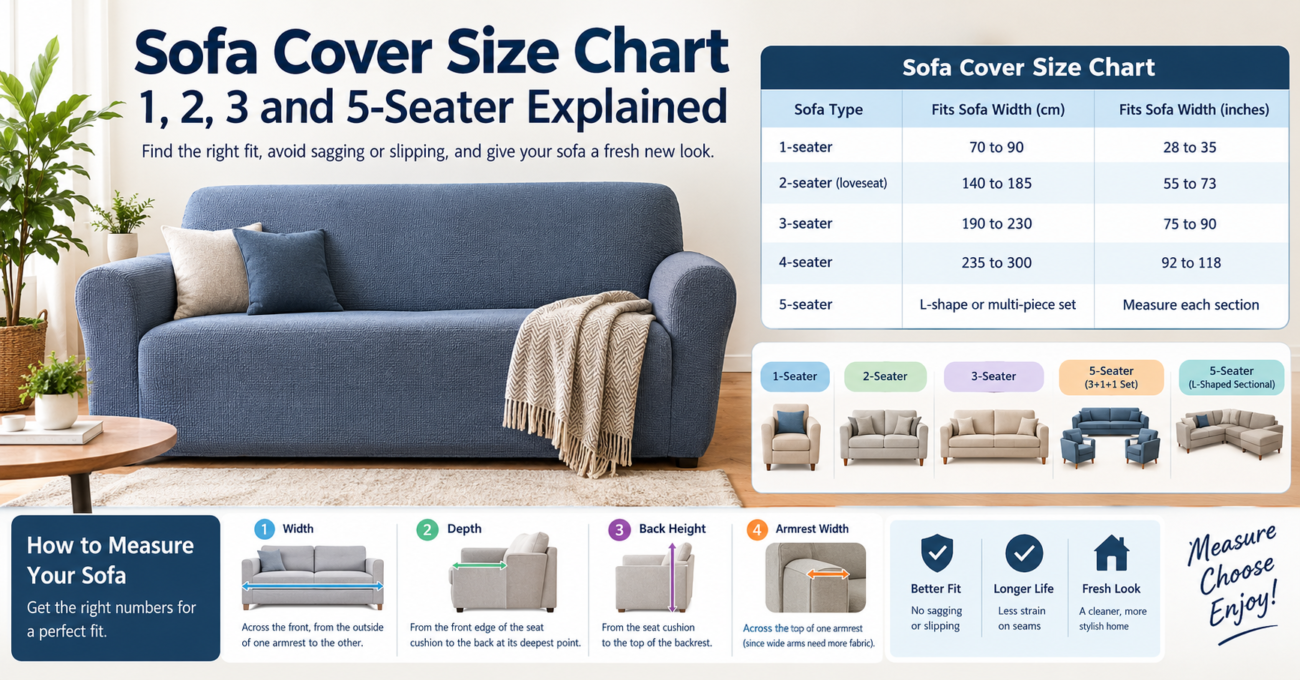
Sofa covers are sold in size ranges, not exact dimensions. A “three-seater” label from one brand might cover a sofa up to 88 inches wide, while another brand’s version stops at 82. If you buy by label alone, you’re guessing. Taking real measurements lets you compare your sofa against a manufacturer’s size chart and pick the right size the first time.
Accuracy also affects how the cover looks and lasts. Fabric that’s stretched too far wears out faster and tends to tear at stress points like the arm corners. Fabric that’s far too large never stays tidy, no matter how often you tuck it in. A few extra minutes with a tape measure prevents both problems.
What You Need Before You Start
You don’t need anything fancy. Gather a flexible fabric or soft tape measure, which wraps around curves better than a metal one, along with a notepad or your phone for recording numbers. A second person helps with long measurements, though it’s not essential. Before you begin, remove loose throw pillows and blankets so you’re measuring the sofa itself, not the clutter on it.
It also helps to decide whether you’ll measure in inches or centimeters and stick with that unit. Most cover size charts list both, but switching back and forth mid-measurement is an easy way to make errors.
Step-by-Step: How to Measure Your Sofa
Work from the outside in: start with the overall dimensions, then move to the details. Write each number down immediately, and label it so you don’t confuse them later.
Measure the Overall Width
Width is the most important number, because it usually determines which size you buy. Measure from the outer edge of one armrest to the outer edge of the other, at the widest point. If your arms bulge outward, measure across the bulge rather than the base, since the cover has to stretch over that widest spot. Hold the tape level and straight, and don’t let it sag in the middle.
Measure the Depth
Depth is the distance from the front of the sofa to the back. Measure from the front edge of the seat cushion, or the furthest point at the front, to the back of the backrest. Keep the tape level with the floor rather than following the slope of the seat. If the backrest leans back sharply, measure to its furthest point, because that’s where the cover will sit.
Measure the Height
Height runs from the floor to the highest point of the backrest. Measure straight up, and don’t count any cushion that sticks above the frame unless it’s permanently attached. If your sofa sits on tall legs, remember that most covers stop at the base of the frame, so you’re really measuring the part the cover will actually wrap, which is the seat-and-back structure itself. Check the product description to see whether the cover is designed to reach the floor.
Measure the Seat and Cushions
The seat area tells you how much fabric must stretch across the part of the sofa you use most. Measure the width of the seat between the two armrests, from the inside edge of one to the inside edge of the other. This number matters because it decides how well the cover will stay put when people sit down and get up.
Cushion Width and Depth
Count how many seat cushions you have and measure each one: width across the front, and depth from front to back. Also note whether the back cushions are separate or part of the frame. Many covers come as one piece for the whole sofa, while others come with separate cushion covers. Knowing your cushion count lets you choose the right style. A two-cushion sofa and a three-cushion sofa of the same overall width need different covers.
Measure the Armrests
Armrests are where poorly fitted covers tend to fail. They’re curved, they come in many shapes, and they take the most strain from the fabric. Measure them separately from the rest of the sofa.
Arm Height and Arm Width
For arm height, measure from the seat surface up to the top of the armrest. For arm width, measure across the top of the arm from the outside edge to the inside edge. Round arms, square arms, and rolled arms all need slightly different cover shapes, so make a note of the style as well. If one arm is wider than the other, which happens more often than you’d think on older sofas, record both numbers and use the larger one.
Measuring Special Sofa Shapes
Not every sofa is a simple rectangle. Each of these shapes needs a slightly different approach:
- Loveseats: Measure exactly as you would for a standard sofa. Loveseats usually fall into a smaller size range, so double-check the chart rather than assuming “two-seater” is enough.
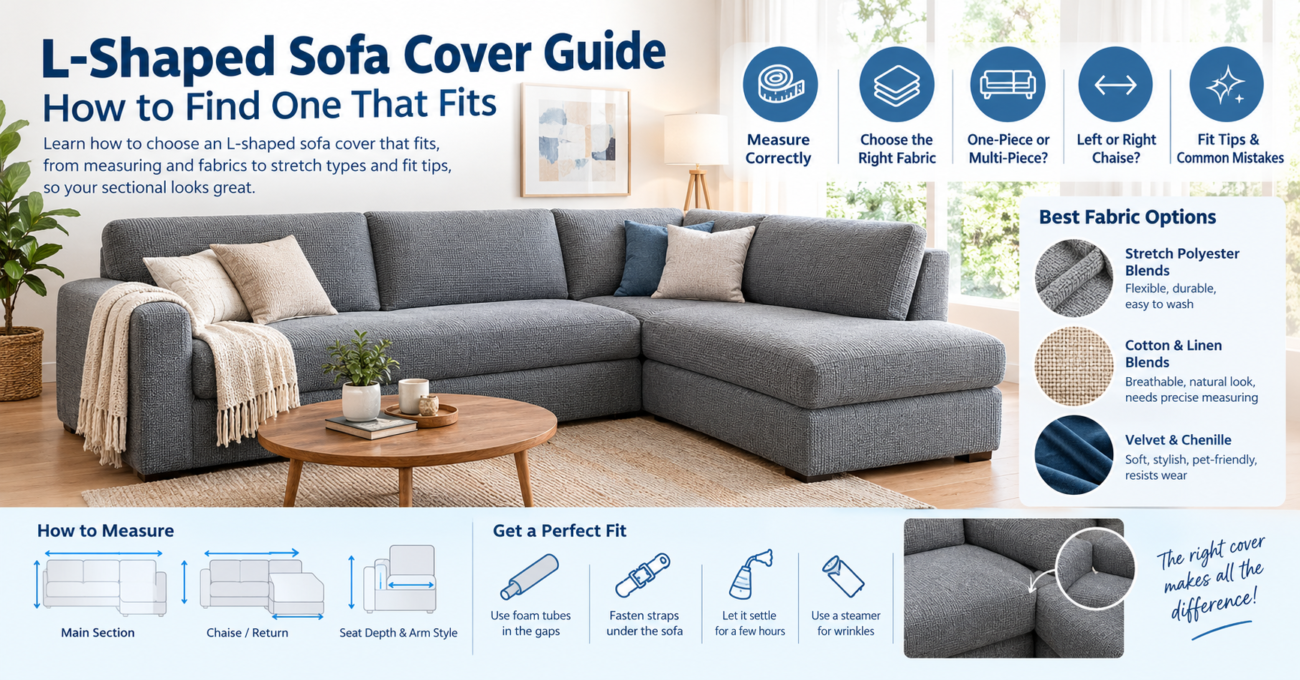
- Sectionals and L-shaped sofas: Measure each section separately, including the length of the long side and the short side (the chaise). Most L-shaped covers are sold as separate pieces, so you’ll need a number for each one.
- Recliners and reclining sofas: Measure with the sofa fully upright. Look for covers labeled as recliner-friendly, which leave room for the mechanism to move.
- Sofas with a skirt or exposed legs: Measure up to the point where you want the cover to end, whether that’s the base of the frame or the floor.
Take extra care with sectionals. Measuring the whole length as a single line will give you a number that fits no cover at all.
How to Read a Sofa Cover Size Chart
Once you have your measurements, compare them against the manufacturer’s size chart. Most brands list a range for each size, such as 72 to 88 inches for a three-seater. Find the size where your width falls inside the range, ideally not right at the edge. If your sofa measures 87 inches and the range tops out at 88, you’re technically covered, but the fit will be tight.
When you land between two sizes, the usual advice is to go up. A slightly larger cover can be tucked in and held with foam sticks or straps, while a cover that’s too small can’t be fixed. Stretch fabrics such as spandex blends are more forgiving than woven or quilted ones, so factor the material in as well. If a brand’s chart only lists width, use your other measurements to check depth and height against the product description.
Common Measuring Mistakes to Avoid
The most frequent error is measuring the wrong part of the sofa. Measuring the seat width instead of the overall width gives you a number that’s several inches too small. Another common slip is measuring along the curve of the arm instead of straight across, which inflates the figure. People also forget to measure the depth at the widest point, especially on sofas with a deep backrest.
Some shoppers skip measuring altogether and rely on the “seater” label, which varies between brands. Others measure once and trust the number. Measure twice, and if the two numbers differ, take a third measurement and use the one that appears most often. Lastly, don’t forget to check the fabric stretch. A cover rated for sofas up to 90 inches won’t always stretch to 90 inches in a heavy cotton blend.
Conclusion
Measuring your sofa for a perfect-fit sofa cover comes down to a few simple steps: overall width, depth, height, seat and cushions, and armrests. Record each number carefully, handle special shapes section by section, and compare your results with the size chart before you buy. When you fall between sizes, choose the larger one and rely on tucking and straps for a tidy finish. A few minutes of careful measuring gives you a cover that looks tailored, stays in place, and protects your sofa for years.
Frequently Asked Questions
Should I size up or down if my sofa is between two cover sizes?
Size up in most cases. A slightly larger cover can be tucked into the crevices and secured with foam sticks or elastic straps, which makes it look snug. A cover that’s too small will pull, slip, and eventually tear. The exception is a very stretchy fabric, which may handle the smaller size if you’re only a little over the lower range.
Do I measure the sofa with or without cushions?
Measure with the seat cushions in place and the loose throw pillows removed. The cover has to fit over the cushions as they sit on the frame, so leaving them out would give you numbers that are too small. If the back cushions are removable, keep them in place for the overall measurements.
How do I measure a sofa with curved or rounded arms?
Measure the arm width at its widest point, straight across, not along the curve. Flexible tape works best. If the arm bulges outward at the middle, measure there, since that’s where the cover will stretch most. Note the arm style too, because round and square arms need different cover shapes.
Can I use a standard sofa cover on a sectional?
Not usually. Sectionals have more than one section, and each needs its own cover or a cover designed for that layout. Measure the long side and the chaise separately and look for covers labeled for L-shaped sofas. Trying to stretch a standard cover over a sectional leaves gaps and loose areas.
How much stretch should a sofa cover have?
It depends on the fabric. Spandex and polyester blends often stretch several inches, which gives you more room for error. Woven or quilted covers stretch very little, so your measurements need to be more exact. Check the product description for the stated size range and choose a size where your sofa falls comfortably inside it, not at the extreme edge.





One thought on “How to Measure Your Sofa for a Perfect-Fit Sofa Cover”