

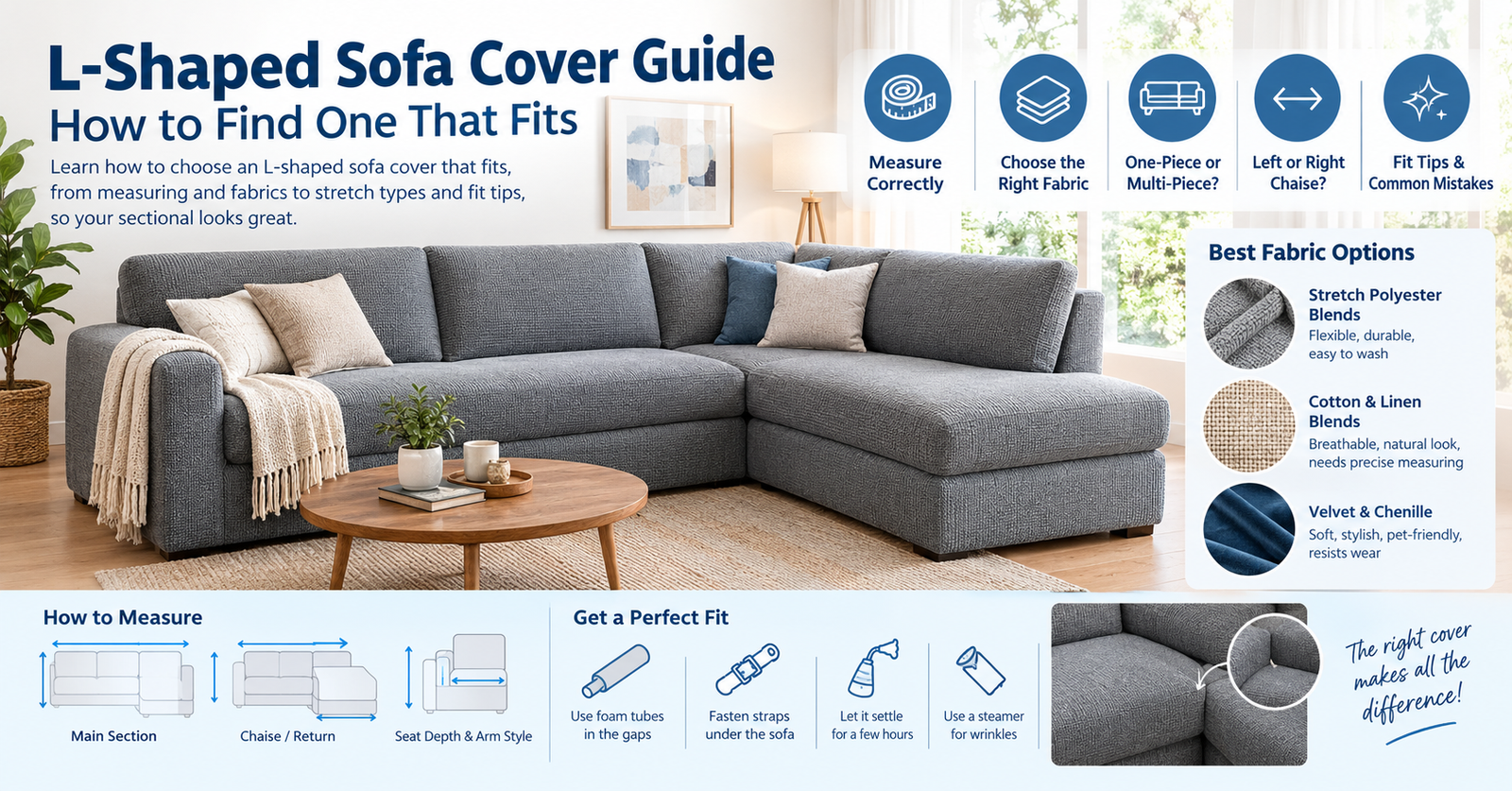
Learn how to choose an L-shaped sofa cover that fits, from measuring and fabrics to stretch types and fit tips, so your sectional looks great.
If you own a sectional, you already know the problem. Ordinary slipcovers don’t reach around the corner, and reupholstering costs more than many people want to spend. A good L-shaped sofa cover fixes both issues, but only if you pick one that actually matches your furniture. Guess wrong and you end up with a baggy chaise, a seam that creeps up the back, or a piece of fabric that stops short of the floor. This guide covers how to measure, which fabrics hold up, and how to get the cover sitting neatly once it arrives.
What Makes an L-Shaped Sofa Cover Different?
A regular sofa has one long run of seat, back, and arms. An L-shaped sectional has two runs joined at a corner, and that corner is where most fit problems begin. The fabric has to wrap a sharp inside angle and still lie flat across both sections, which is much harder than covering a straight sofa.
Sectionals also vary far more than standard sofas. Some have a short chaise, others a long one. Some have arms on both ends, others only on one. Some are a single frame, and others are two pieces pushed together. So a cover labeled “large” tells you very little. You need to know exactly what shape you’re dressing before you shop.
How to Measure for an L-Shaped Sofa Cover
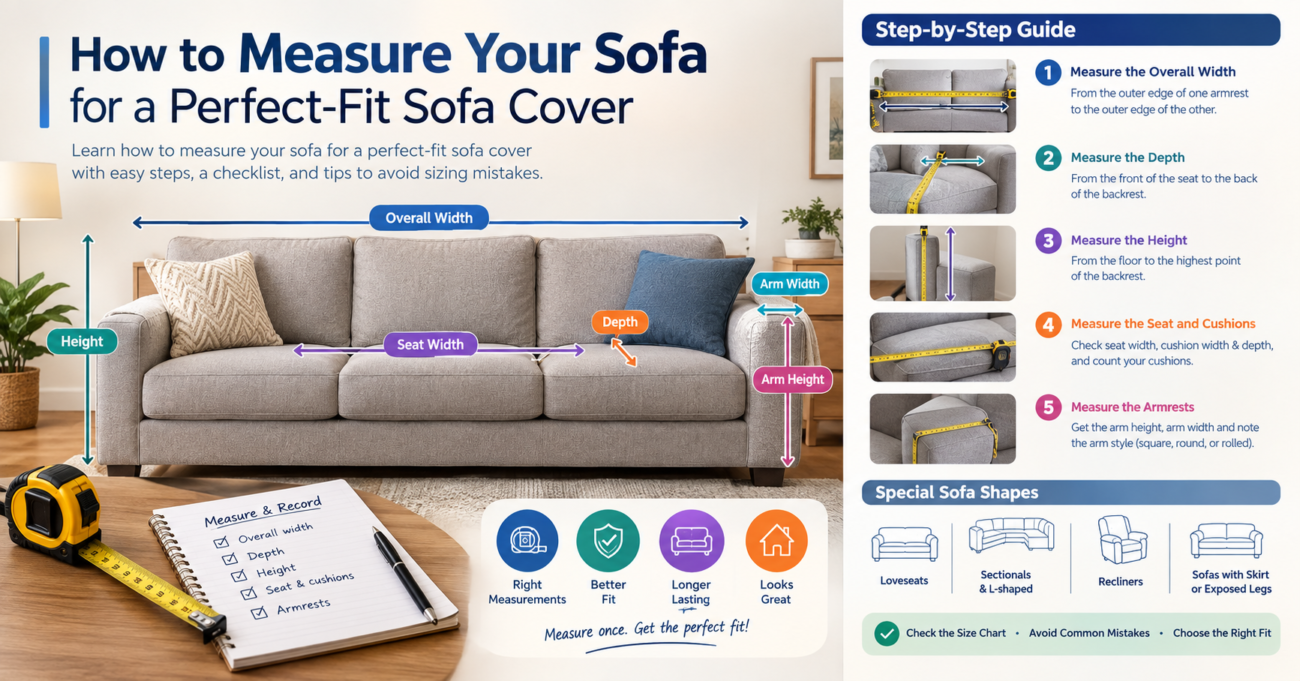
Measuring takes about ten minutes, and it’s the step that prevents returns. Grab a soft tape measure, a notepad, and write every number down as you go. Most manufacturers list size ranges rather than exact dimensions, so you’ll compare your numbers against their chart.
Measure the Main Section
Start with the long side of the L. Measure from the outside edge of one arm to the outside edge of the corner where the two sections meet. Then measure the height of the backrest from the seat cushion to the top of the back. Finish by measuring the full height from the floor to the top of the back, since some covers hang lower than others.
Measure the Chaise or Return
Now do the shorter side. Measure from the corner to the open end of the chaise, following the front edge of the seat. Then measure the chaise width, side to side. Many people forget this step and assume the chaise matches the main section. It rarely does, and a cover designed for a narrow chaise will pull awkwardly across a wide one.
Check Seat Depth and Arm Style
Seat depth runs from the front edge of the cushion back to the backrest. Deep, lounge-style sectionals need covers with extra length, or the front will sit short and show the sofa underneath. Arm style matters too. Rolled arms, square arms, and wide track arms all need different cuts. Check whether the product page says it suits your arm shape, and look at the photos closely.
One-Piece or Separate Pieces?
An L-shaped sofa cover usually comes one of two ways. A one-piece cover looks seamless but is harder to put on, because you wrestle one big sheet around an awkward shape. A multi-piece set gives you a separate cover for the main section, the chaise, and often each cushion. Setup is easier, and if one piece gets stained, you can wash it alone.
If your sectional has a gap or a visible seam where the two sections meet, go for the multi-piece set. It follows that break naturally. If the frame is one continuous piece, a one-piece cover will look cleaner. Think about your patience too. Pulling a large stretchy sheet over a heavy frame is a two-person job.
Picking the Right Fabric
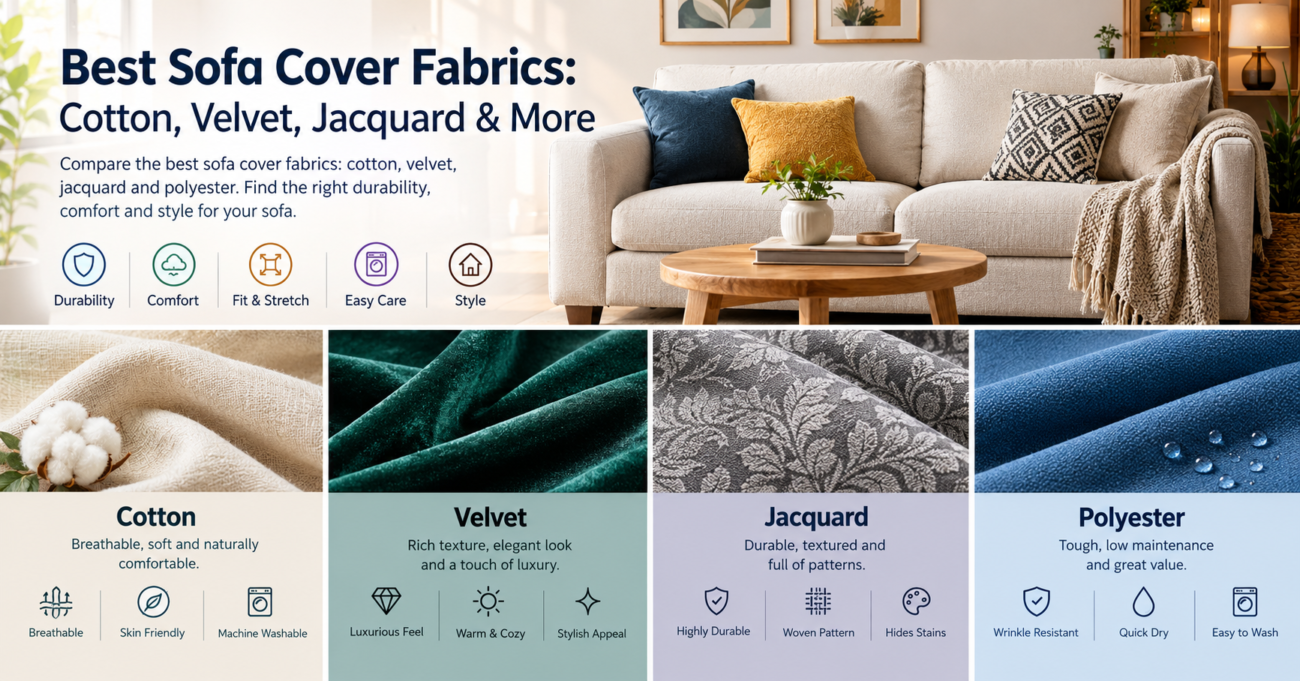
Fabric affects how well the cover stays in place, how it looks after a few weeks, and how much care it needs. The wrong choice can ruin an otherwise perfect fit.
Stretch Polyester Blends
Most L-shaped sofa covers use a polyester and spandex blend, and there’s a good reason. The stretch lets the fabric hug curves and corners, so it forgives small measurement errors. These covers are also usually machine washable and dry quickly. The downside is that thin versions can look shiny or cling too tightly. Look for a thicker knit, often described by weight in GSM, for a more upholstered feel.
Cotton and Linen Blends
Natural blends look relaxed and breathe well, which suits warm rooms. They give you that casual, lived-in slipcover look. They stretch less, though, so measuring has to be more precise. They also wrinkle and may shrink slightly if washed hot, so follow the care label closely.
Velvet and Chenille
These soft, textured fabrics add warmth and look more expensive than plain knits. They resist pet claws better than loose weaves, which helps if you have cats. They can show marks and crush patterns, so brush them occasionally and avoid very dark shades if you have light-colored pets.
Left-Hand or Right-Hand Chaise
This one catches buyers out constantly. Chaise orientation depends on which side the chaise sits on when you face the sofa from the front. Stand in front of it, look at it as if you were about to sit down, and note whether the chaise is on your left or your right. Many covers are sold as reversible, but not all of them are. If the listing doesn’t say, ask the seller before buying. A cover cut for the opposite side won’t fit no matter how hard you pull.
Tips for a Smooth, Wrinkle-Free Fit
Getting the cover on is only half the job. These small habits make the difference between a rumpled look and a tailored one.
- Pull the cover over the main section first, then the chaise, and smooth each piece outward from the center.
- Tuck foam tubes or rolled towels into the gaps between the seat and the arms to hold the fabric in place.
- Fasten any straps or elastic bands under the sofa so the cover doesn’t shift when people sit down.
- Let the cover rest for a few hours after you put it on. Stretch fabric settles into the shape of the sofa.
- If wrinkles remain, use a steamer on a low setting, keeping it at a distance from the fabric.
Common Mistakes to Avoid
The biggest mistake is measuring once, in a hurry. Double-check each number, especially the chaise. The second is choosing a cover by price alone. Cheap, thin fabric often tears at the corner seams, which take the most strain on an L-shaped sofa cover. The third is ignoring cushion count. Your sectional may have three seat cushions or five, and the cover has to match.
Another common slip is trusting a “fits all sectionals” claim. No cover fits every L-shape. Stick to a stated size range and compare it against your own measurements. Last, read the care instructions before the first wash. Hot water and high heat can warp the elastic and ruin the fit.
Conclusion
Finding an L-shaped sofa cover that fits comes down to preparation. Measure both sections, check the chaise side and seat depth, decide between one-piece and multi-piece, and choose a fabric that suits your household. A little time up front saves you from returns and from living with a cover that never sits right. Get those details sorted and your sectional can look fresh again without the cost of new furniture.
Frequently Asked Questions
How do I know if an L-shaped sofa cover will fit my sectional?
Compare your measurements to the manufacturer’s size chart, not just the product title. Check the length of the main section, the chaise length, the seat depth, and the seat back height. If your sofa falls between two sizes, pick the larger one when the fabric is stretchy, since stretch fabric tightens more easily than it loosens.
Can one cover fit both left-hand and right-hand chaise sofas?
Some can, but not all. Reversible covers are made with symmetrical panels so the chaise can sit on either side. Always check the listing for the words “reversible” or “universal” before you order, and confirm with the seller if it isn’t clear.
Are L-shaped sofa covers machine washable?
Most polyester blend covers are machine washable on a gentle cycle with cold water. Cotton, linen, and velvet covers often need more careful treatment, so read the care label. Washing multi-piece sets one section at a time is easier on your machine.
How do I stop my sofa cover from slipping?
Push foam tubes into the gaps around the seat, use the straps that come with the cover, and tuck the fabric firmly into the crevices. Anti-slip pads under the cushions help too. A properly sized cover slips far less than one that’s too large.
Will a sofa cover protect against pets and spills?
Yes, to a point. Tightly woven fabrics repel hair and light spills, while water-resistant versions give extra protection against liquids. Neither makes your furniture invincible, so wipe up spills quickly and wash the cover regularly to keep it in good shape.

One thought on “L-Shaped Sofa Cover Guide: How to Find One That Fits”