

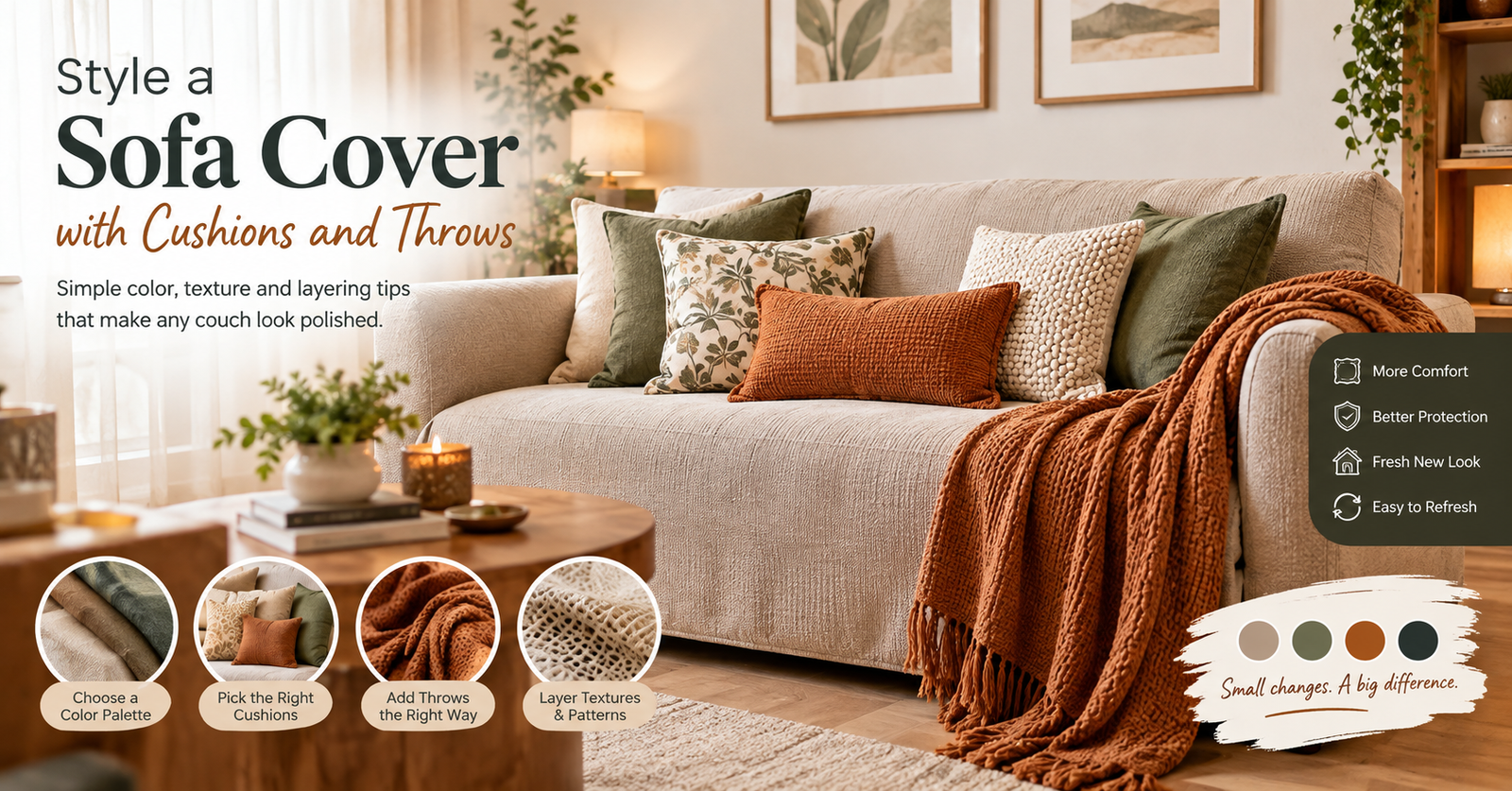
Learn how to style a sofa cover with cushions and throws using simple color, texture, and layering tips that make any couch look polished.
A sofa cover does a lot of quiet work. It protects your couch from spills, pet hair, and sunlight, and it can give an old sofa a fresh start. But a plain cover on its own can look flat, like a sofa wearing a uniform. Learning how to style a sofa cover with cushions and throws is what turns it from something practical into something that actually looks like part of your room.
The good news is that you don’t need a designer’s budget or a big shopping trip. A few well-chosen cushions and one or two throws can change the whole mood of a living room. Let’s walk through how to do it, step by step.
Why Styling a Sofa Cover Matters
Most sofa covers are made in solid, neutral shades because they need to fit many homes. That’s helpful when you’re buying one, but it also means the cover leaves a lot of blank space. Cushions and throws fill that space with personality.
Styling also solves a few real problems. Covers can look slightly loose or boxy, especially on larger sofas. Soft accessories break up those straight lines and make the whole piece look intentional. They also add comfort, which is the whole point of a sofa in the first place.
Start With the Sofa Cover Itself
Before you buy anything, look closely at what you already have. The color, fabric, and texture of your sofa cover decide what will work on top of it. A smooth cotton cover behaves very differently from a ribbed stretch cover or a quilted one, and the accessories you pick should respond to that.
Choose a Color Palette
Think of your cover as the base color in a painting. Everything else is there to support it or contrast with it. If you have a neutral cover in grey, beige, cream, or charcoal, you have the most freedom. You can bring in almost any color without things clashing.
A simple approach is to pick three colors: one dominant shade that appears most often, one supporting shade, and one accent. For example, on a warm grey cover you might use cream as the main cushion color, soft sage as the supporting shade, and a small touch of terracotta as the accent. If your cover is already bold, like navy or deep green, keep your accessories calmer and let the cover be the star.
Try pulling colors from something else in the room, such as a rug, a painting, or the curtains. That instantly makes the sofa feel connected to the space around it.
Pick the Right Cushions
Cushions are the fastest way to change how a sofa cover looks. They add color, pattern, and softness, and you can swap them out with the seasons without touching the cover at all.
Mix Sizes and Shapes
A row of identical square cushions can look stiff. Mixing sizes gives the sofa a relaxed, layered feel. A good starting point is to combine large squares around 50 to 60 cm (20 to 24 inches) at the back, medium squares in front of them, and one lumbar or rectangular cushion to finish the group.
Place the biggest cushions at the corners and in the back row, then work forward with smaller ones. This gives depth, a bit like arranging people for a group photo with the tallest at the back.
The Rule of Odd Numbers
Designers often work in odd numbers because uneven groupings look more natural than perfectly matched pairs. On a standard two-seater, three cushions usually look right. On a three-seater, try five. If your sofa is large and you prefer symmetry, you can still use pairs at each end, but add one odd piece in the middle to soften the look.
That said, this is a guideline, not a law. If you love a symmetrical arrangement, go with it. The goal is a sofa that looks good to you.
Layer Textures and Patterns
Texture is what makes a styled sofa feel rich rather than flat. If your sofa cover is smooth, add cushions in velvet, linen, bouclé, or chunky knit. If your cover already has a noticeable texture, such as ribbing or quilting, balance it with smoother fabrics.
Patterns can work well too, as long as you keep them under control. A simple formula is to use one solid, one subtle pattern like small stripes or a tonal weave, and one bolder pattern like a floral or geometric print. Keep all three within the same color family and they’ll look like they belong together. When in doubt, add more solids than patterns.
Add Throws the Right Way
If cushions are the main act, throws are the finishing touch. A throw adds another layer of texture and gives the sofa a lived-in, welcoming look. It’s also useful in practice: you can pull it over your legs on a cool evening.
Draping vs. Folding
There are two popular ways to place a throw, and each gives a different feel.
- Casual drape: Let the throw fall over one arm or across a corner of the sofa, with one end hanging naturally. This looks relaxed and works well in family rooms.
- Neat fold: Fold the throw into a long, narrow rectangle and lay it across the back or the seat edge. This looks cleaner and suits more formal living rooms.
Whichever you choose, avoid spreading the throw flat across the whole seat. It hides your sofa cover and tends to slip off. Let part of the cover show so the layers read as separate pieces.
Pick a throw that adds something the cushions don’t already have. If your cushions are mostly smooth, choose a chunky knit or a woolly blanket. If the cushions are very textured, a lightweight cotton or flat-weave throw will keep things from feeling heavy. Colors can echo one of your cushions, which ties everything together without matching exactly.
Common Mistakes to Avoid
Even a good set of cushions can look messy if a few habits sneak in. Here are the ones worth watching for.
Too many cushions. It’s tempting to keep adding, but if there’s no room left to sit, the sofa stops being useful. As a rough guide, leave at least half of each seat clear.
Everything matching. A perfectly matched set can look like a catalog display rather than a real home. Vary the shades slightly while keeping the same family of colors.
Ignoring the cover’s fit. If your sofa cover is wrinkled or sagging, no amount of styling will hide it. Smooth it out, tuck it firmly into the seams, and use foam tubes or tuck-in strips if needed. Cushions look far better on a tidy base.
Forgetting maintenance. Throws and cushion covers collect dust and pet hair. Choose washable fabrics where you can, and refresh your arrangement every few weeks so it keeps looking its best.
Clashing with the room. Your sofa doesn’t sit alone. Check your styling against the rug, walls, and curtains so everything feels like one space.
Conclusion
Styling a sofa cover comes down to a few clear choices: a simple color palette, cushions in mixed sizes and textures, and a throw that adds one more layer of comfort. Start with what your cover already gives you, build around it with odd-numbered groupings, and keep the arrangement relaxed enough to actually use. Once you get the basics right, you can switch cushions and throws with the seasons and give the same sofa a new look whenever you like.
Frequently Asked Questions
How many cushions should I put on a sofa cover?
A two-seater usually looks balanced with three cushions, and a three-seater with five. Odd numbers tend to look more natural, but the real test is comfort. If you can’t sit down without moving half of them, you have too many.
What colors go best with a grey sofa cover?
Grey is very flexible. Warm tones like mustard, terracotta, and blush add energy, while blues and greens create a calmer feel. For a softer, more neutral look, layer cream, white, and tan with a touch of texture.
Can I mix patterns on a sofa with a cover?
Yes, as long as you keep them related. Combine one bold pattern with a smaller or more subtle one and a few solids, and stick to one color family. Too many competing prints in different color schemes is what makes a sofa look cluttered.
How do I keep a throw from sliding off the sofa?
Choose a throw with a bit of weight, like wool, chunky knit, or heavy cotton, since lightweight fabrics slip more easily. Draping it over the arm or folding it across the back gives it more grip than spreading it across the seat. A non-slip mat under the throw can help in a pinch.
How often should I change my sofa cushions and throws?
There’s no fixed schedule, but many people refresh them with the seasons. Lighter fabrics and brighter colors suit spring and summer, while heavier knits and deeper shades feel right in autumn and winter. Even swapping just the cushion covers is enough to make the room feel new.











One thought on “Style a Sofa Cover with Cushions and Throws”